Canaries and Empire
In the Apple TV series Foundation
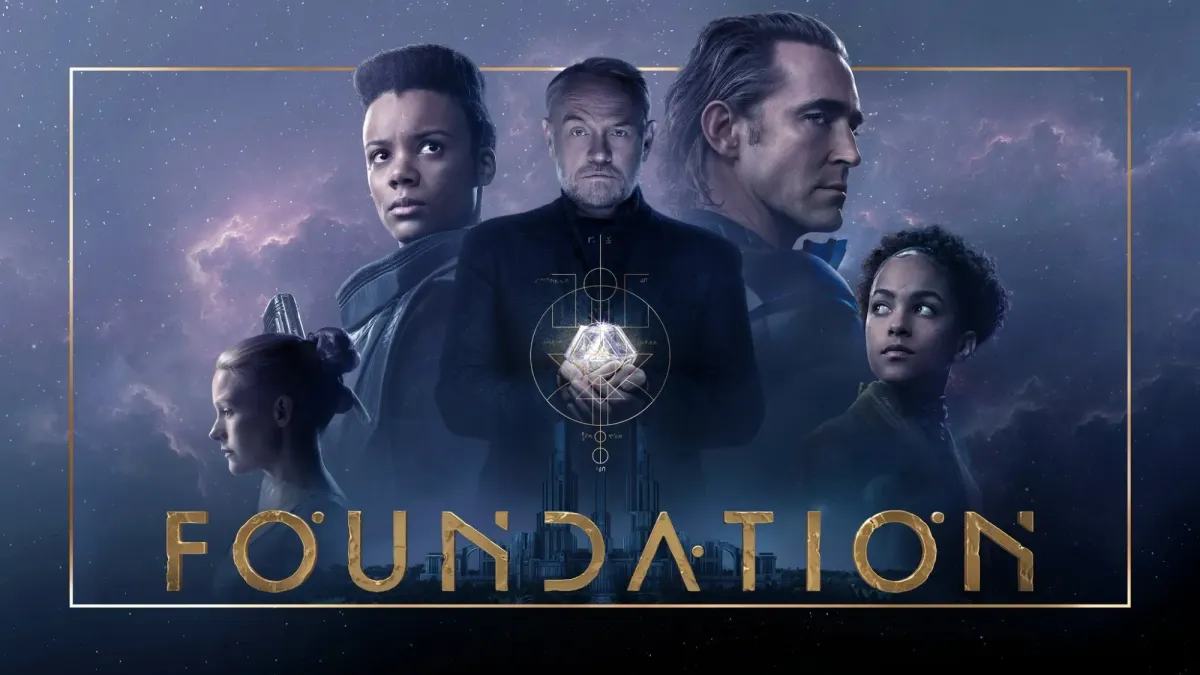
⬇️ SPOILER-FREE ZONE STARTS HERE ⬇️
Dominant systems thrive on legibility — measuring, categorizing, and predicting people to maintain control (Benjamin, 2019). These systems privilege sameness: standardized laws, shared languages, and rigid norms define who “fits” and who’s treated as a problem.
Neurodivergence complicates this design. Divergent ways of sensing, processing, and communicating often reveal cracks in systems of control long before anyone else notices (Walker, 2021). That’s why the metaphor of the “canary in the coal mine” has been adopted within parts of the neurodivergent community.
Autistic writer Freestone Wilson reframed the metaphor in the 1990s: if autistic and neurodivergent people are the canaries, then the answer isn’t to silence or pathologize us — it’s to clean the air (Stimpunks Foundation, 2022). The problem isn’t our sensitivity; the problem is the toxicity of the environments we’re placed in.
This reframing invites us to imagine another way forward:
Outlier perception isn’t a flaw to fix but a resource for collective survival (Walker, 2021). Non-dominant communication — from sign languages to AAC to scripted dialogue — resists systems built to erase difference (Connor et al., 2016). Thriving together requires us to expand our definitions of intelligence, value, and belonging beyond what systems of control can measure (Erevelles, 2011).
The task isn’t to make people better at surviving toxic environments.
The task is to clean the air — together.
⚠️ Spoilers Beyond This Point: This essay contains significant plot details from Apple TV+’s Foundation.
The Canary’s Warning and Its Cost
Neurodivergent people are often described as society’s “canaries in the coal mine” — attuned to danger, sensing fractures before anyone else. The metaphor comes from mining history: for over a century, miners carried canaries into tunnels because the birds’ heightened sensitivity to toxic gases would warn them of danger before it reached human lungs. Miners used small animals as early-warning sentinels (in some contexts, including Colorado, mice), and canaries became emblematic because their distress was easy to see (Eschner, 2024; Trembath, 2020).
In recent decades, parts of the neurodivergent community have reappropriated the metaphor. In the 1990s, autistic writer Freestone Wilson described autistic people as “miners’ canaries of civilization,” urging society not to silence or pathologize the canary but instead “clean the air” so no one needs to serve as an early warning (Stimpunks Foundation, 2022).
That reframing matters. Our heightened perception — of sensory overload, systemic fractures, environmental toxicity, cultural contradiction — isn’t fragility. As Milton (2012) argues, neurodivergent suffering often reflects environments designed without us in mind, not innate deficiency. And as Puar (2017) shows, systems distribute harm unevenly, making some bodies and minds more vulnerable by design.
Difference as Disruption: Lessons from Foundation
Foundation imagines a universe where sameness is policy and unpredictability is a threat. On Trantor, the Imperial Palace gleams with symmetry. Three cloned emperors — Brother Dawn, Brother Day, Brother Dusk — move like a single organism. Rituals are repeated, gestures rehearsed. Control is staged as perfect repetition.
Even Hari Seldon’s Psychohistory — the mathematics used to model civilizations — assumes that individual actions don’t matter because the collective is predictable. As Hari tells Gaal Dornick in S1E1:
“Psychohistory cannot account for the actions of individuals.”
(Foundation, Season 1, Episode 1)
Empire takes comfort in this. If the collective can be modeled, so can control. But outliers like Gaal Dornick, Salvor Hardin, and the Mentalics repeatedly break the model, revealing the limits of systems built on prediction.
Outlier Minds That Shift History
Gaal Dornick
On Synnax, inquiry is forbidden. Faith governs knowledge, and questioning is dangerous. Gaal’s decision to solve the Seldon problem exiles her — leaving family, belief, and planet behind.
When she arrives on Trantor in S1E1, the tribunal chamber dwarfs her. The Cleon clones descend in unison, their mirrored bodies signaling an unbroken lineage. Gaal’s voice is soft, but when she answers, the room stills.
In S1E2 (“Preparing to Live”), aboard Hari’s ship, we see a moment that sets her apart: when the vessel jumps to hyperspace, the entire crew loses consciousness — except Gaal. Her eyes open; her breathing quickens. The episode doesn’t show what she experiences internally, but we see her awake, tense, present in a moment designed to erase awareness.
This is one of the first times the show hints at her difference: she senses and endures realities others can’t. That uniqueness becomes both her strength and her isolation.
Salvor Hardin
Salvor moves through the world differently too. On Terminus, she senses danger before anyone else does — patterns others don’t yet see. In S1E7 (“Mysteries and Martyrs”), the Foundation clings to a mantra: “Violence is the last refuge of the incompetent.” But when Salvor sees an Anacreon strike team advancing, she grabs a weapon. Doctrine says one thing; her instincts say another. She survives by trusting what she knows, even when it contradicts what everyone else believes.
On Ignis in S2E8 (“The Last Empress”), Salvor faces Tellem Bond, leader of the Mentalics, who uses psychic force to subdue her. We see Salvor’s strain — her body tensing, breath catching — before Tellem pivots tactics, threatening Gaal to secure her compliance.
The scene tells us two things: Salvor isn’t immune to psychic control, but she’s harder to manage than most. Her independence, intuition, and outlier cognition make her less predictable — and in a world built on prediction, unpredictability is dangerous.
Why They Matter
Gaal and Salvor live as disruptions to the systems around them. Psychohistory assumes individuals don’t matter; Empire depends on sameness to maintain control. Yet here they are: variables no equation accounts for.
This is what makes them resonate as metaphors for neurodivergence — not because they’re extraordinary, but because their ways of sensing and knowing don’t align with what the system expects. Their existence exposes the limits of systems built on “normality,” and hints at the survival value of difference.
Language Beyond the Empire’s Reach
In S2E7 (“A Necessary Death”), when the Mentalics first confront Gaal and Salvor, they communicate rapidly in sign. The meaning is private, layered, inaccessible to outsiders — and invisible to Empire.
Empire thrives on legibility: the power to make people measurable, predictable, and controllable (Benjamin, 2019). Across the show, we see this impulse in law, ritual, and language:
In S1E1, after the Starbridge bombing, the Empire stages mass “justice” by casting 100,000 people into the sky — violence as narrative control.
In the same episode, Hari and Gaal’s trial isn’t about evidence; deviation itself is the offense.
The Foundation Charter binds Terminus to Empire, showing how even “resistance” is managed within imperial frameworks.
The ceremonies on Trantor are rehearsed, the rituals scripted, and public performances choreographed — all reinforcing a singular story of control.
This makes the Mentalics’ sign language subversive. Their embodied communication lives outside Empire’s legibility.
For many neurodivergent people, alternative forms of communication — AAC devices, echolalia, scripted dialogue, gestural “languages” — are treated as deficits, even when they’re rich, shared systems of meaning (Connor et al., 2016). Historically, marginalized communities have built languages power cannot parse—from Black American Sign Language, shaped in part by the history of segregated Deaf schooling (McCaskill et al., 2011), to spirituals that sometimes carried layered meanings and could function as signals under slavery (Lawrence-McIntyre, 1987; Library of Congress, n.d.), to queer anti-languages like Polari in twentieth-century Britain (Baker, 2020; Taylor, 2007).
In Foundation, Ignis suggests something profound: the futures we need may already exist in languages dominant systems can’t read.
Demerzel and the Weaponization of White Femininity
In S2E10 (“Creation Myths”), Demerzel commits an act that clarifies her function within Empire: she kills Brother Dusk (and Rue) to protect the imperial machinery, and then oversees the continuity of the Cleonic line even as Brother Day’s fate is sealed elsewhere.
Demerzel’s chosen visage — that of a white woman serving cloned white emperors — matters. Historically, white femininity has often been co-opted to uphold white supremacist and patriarchal systems, even against women’s own interests (Benjamin, 2019). Demerzel literalizes this: a trusted, “benevolent” face enforcing control, programmed to preserve a system that denies her autonomy.
Risks and Limits of the Metaphor
Even with Freestone Wilson’s reframing, there are risks in leaning too heavily on the canary metaphor. Casting outlier perception as what “saves” us can slip into genius-exceptionalism, suggesting neurodivergent lives only matter when they deliver extraordinary insight (Walker, 2021).
And romanticizing the suffering itself can obscure the real issue: the “mine” is dangerous because it was designed without us in mind. Pain isn’t meaningful because it warns; it’s widespread because systems distribute it unevenly (Puar, 2017).
The point isn’t to make canaries tougher.
The point is to clean the air so no one has to serve as the warning.
Disability, Race, and Power
Foundation imagines what society too often resists: difference as a condition of survival.
Gaal and Salvor’s cognition — feared, dismissed, misunderstood — becomes essential precisely because it doesn’t fit Empire’s definition of “normal.” And it matters that these insights come through Black women’s bodies in a story where power is visualized as white, masculine, and endlessly replicated (Hill Collins, 2000).
Thriving won’t come from enforcing sameness. It will come from embracing the fullest spectrum of human minds, bodies, and ways of being — and letting go of the fantasy that survival can be built on exclusion (Erevelles, 2011).
A Call to Listen
When neurodivergent people say we are burning out, drowning, or breaking under current systems, we are not foreshadowing someone else’s crisis — we are naming ours (Milton, 2012).
If society listens, these signals can guide us toward building environments that honor the full range of human experience and ensure no one is left behind.
Because difference isn’t the problem.
The problem is how we build worlds that demand some of us be sacrificed so others can feel safe.
We don’t need stronger canaries.
We need cleaner air.
Listening to those who sense the fractures first isn’t about turning them into warnings — it’s about creating a future where no one has to serve as one.
Note: This essay reflects seasons 1–2 and was written mid-watch; I may add follow-up as I sit with later arcs and characters.
References
Baker, P. (2020). Fabulosa!: The story of Polari, Britain’s secret gay language. Reaktion Books.
Benjamin, R. (2019). Race after technology: Abolitionist tools for the New Jim Code. Polity Press.
Connor, D. J., Ferri, B. A., & Annamma, S. A. (Eds.). (2016). DisCrit: Disability studies and critical race theory in education. Teachers College Press.
Erevelles, N. (2011). Disability and difference in global contexts: Enabling a transformative body politic. Palgrave Macmillan.
Eschner, K. (2024, March 7). What happened to the canary in the coal mine? The story of how the real-life animal helper became just a metaphor. Smithsonian Magazine. https://www.smithsonianmag.com/smart-news/what-happened-canary-coal-mine-story-how-real-life-animal-helper-became-just-metaphor-180961570/
Hill Collins, P. (2000). Black feminist thought: Knowledge, consciousness, and the politics of empowerment. Routledge.
Lawrence-McIntyre, C. C. (1987). The double meaning of the spirituals. Journal of Black Studies, 17(4), 379–401.
Library of Congress. (n.d.). Spirituals. In The Library of Congress celebrates the songs of America. https://www.loc.gov/collections/songs-of-america/articles-and-essays/musical-styles/ritual-and-worship/spirituals/
McCaskill, C., Lucas, C., Bayley, R., & Hill, J. (2011). The hidden treasure of Black ASL: Its history and structure. Gallaudet University Press.
Milton, D. (2012). On the ontological status of autism: The “double empathy problem.” Disability & Society, 27(6), 883–887. https://doi.org/10.1080/09687599.2012.710008
Puar, J. K. (2017). The right to maim: Debility, capacity, disability. Duke University Press.
Stimpunks Foundation. (2022, June 22). Canary. https://stimpunks.org/glossary/canary/
Taylor, H. (2007). Polari: A sociohistorical study of the life and decline of a secret language [Undergraduate dissertation, The University of Manchester]. https://languagecontact.humanities.manchester.ac.uk/McrLC/casestudies/HT/HT_Polari.pdf
Trembath, B. K. (2020, April 29). For Colorado coal miners, the canary in the coal mine was actually a mouse. Denver Public Library. https://history.denverlibrary.org/news/colorado-coal-miners-canary-coal-mine-was-actually-mouse
Walker, N. (2021). Neuroqueer heresies: Notes on the neurodiversity paradigm, autistic empowerment, and postnormal possibilities. Autonomous Press.